thegoldenadventure.com

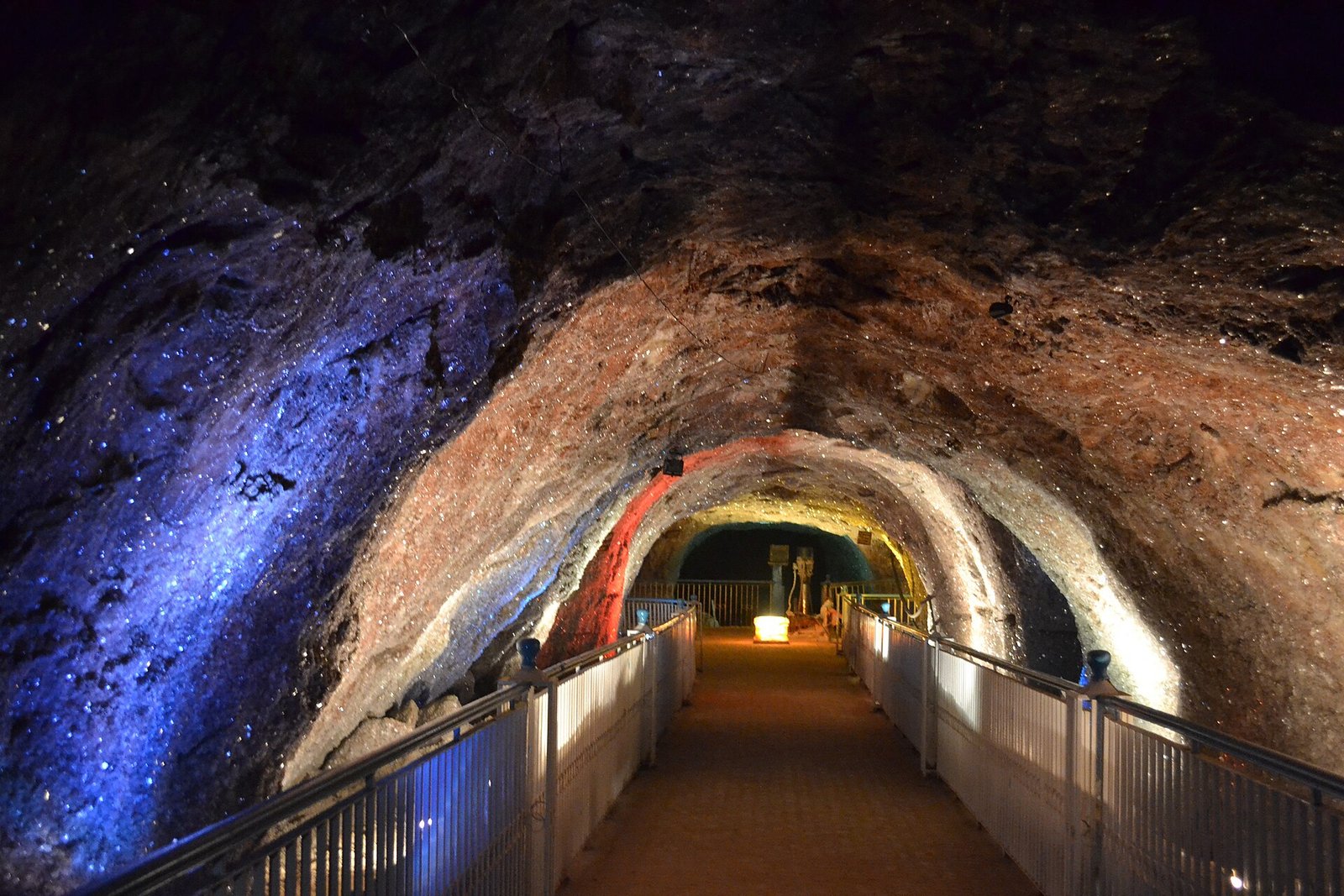
Khewra Salt Mine: salt crystal deposits inside the mine
Destination guide

Khewra Salt Mine: The Complete Travel Guide

Khewra Salt Mine takes you deep inside the Salt Range, through tunnels of glowing pink and red rock salt to a mosque built entirely from salt bricks.

Updated October 2026By The Golden Adventure team
Photo: Shikari7 / Wikimedia Commons, CC BY-SA 3.0 (source)

Khewra Salt Mine at a Glance

Khewra Salt Mine, also known as the Mayo Salt Mine, is often described as the second-largest salt mine in the world. It is still a working mine run by a government corporation, with a show section of galleries, salt sculptures and an old mine railway open to visitors.

LocationKhewra, near Pind Dadan Khan, Jhelum district, Punjab
AltitudeAbout 288 m (945 ft) at the entrance
Best time to visitOctober to April; check for monsoon closures in July–September
Getting thereBy road from Islamabad or Lahore via the M-2 motorway and the Lilla interchange
Top sightsSalt-brick mosque, Assembly Hall, Sheesh Mahal, mine railway, salt carvings
Known forPink Himalayan rock salt, about 40 km of tunnels, salt therapy ward

Where Is Khewra Salt Mine?

The mine lies in the Salt Range, the low, rugged hills that run across northern Punjab between the Jhelum and Indus rivers. The town of Khewra is just north of Pind Dadan Khan in Jhelum district.

From the M-2 motorway, the usual route leaves at the Lilla interchange and follows the Lilla road for about 30 km towards Pind Dadan Khan. Sources put the mine at roughly 160–200 km from both Islamabad and Lahore, depending on the route you take, which makes it a realistic day trip from either city.

History of the Salt Mine

Local legend credits the discovery to the horses of Alexander the Great’s army, which were seen licking the rocks around 326 BC. Whatever the truth, salt from this range was being traded by the Mughal era, reportedly as far as Central Asia.

Modern mining began under British rule. In 1872 the mining engineer H. Warth developed the main tunnel, which is still the spine of the visitor route. The mine is now operated by the Pakistan Mineral Development Corporation and produced around 350,000 tonnes of rock salt in 2019–20.

A mine, not a theme park

The tunnels extend for about 40 km, and the mine has nineteen levels, eleven of them underground. Visitors see only a small, lit section near the entrance; the rest remains a working industrial site.

MUST-SEE EXPERIENCES

Top 8 Things to Do in Khewra Salt Mine

The show section is compact, but there is plenty to see if you take your time.

  1. 01
    Culture

    The salt-brick mosque

    A small mosque built from blocks of coloured rock salt, lit from within so the walls glow pink and amber. It is the image most people come for.

  2. 02
    Nature

    Assembly Hall

    A huge excavated chamber reported to be about 75 m high, showing the sheer scale of more than a century of mining. Look up to see the layered bands of salt in the ceiling.

  3. 03
    Adventure

    The mine railway

    An old mine train, reported to date from around 1930, carries visitors into the tunnels for an extra fee. It is a fun way to start, especially with children, and saves part of the 1.5 km walk.

  4. 04
    Culture

    Sheesh Mahal

    One of the named galleries on the visitor route and a favourite photo stop. Ask your guide to point out the different colours of salt here.

  5. 05
    Culture

    Salt carvings

    Look out for a salt replica of Lahore’s Minar-e-Pakistan and a model of Murree’s Mall Road.

  6. 06
    Nature

    Brine pools

    Still, salt-saturated pools sit in some chambers, reflecting the lit walls. Heavy monsoon rain can raise their levels, which is one reason the mine sometimes closes to visitors.

  7. 07
    Culture

    Salt therapy ward

    Since 2007 a small ward inside the mine has offered salt therapy for asthma patients. It is a local tradition, not a substitute for medical advice.

  8. 08
    Food

    Salt shopping

    Shops at the entrance sell salt lamps, carved models and cooking salt. They make light, inexpensive souvenirs, but check your home country’s customs rules.

Best Time to Visit Khewra Salt Mine

The drive and the time spent outside are far more pleasant from October to April. Summer days in the Salt Range are very hot.

The monsoon matters most. In August 2026, heavy rain raised water levels inside, and the manager confirmed the mine had stopped admitting tourists until the monsoon ended, according to ProPakistani. If you plan to travel between July and September, confirm that the mine is open shortly before you go. Weekends and public holidays are much busier with domestic visitors.

How to Get to Khewra Salt Mine

A private car is by far the most practical option, as the last stretch is on rural roads with limited public transport.

FromRouteDistanceNotes
IslamabadM-2 south, exit at LillaAbout 160–200 kmLong day trip; leave early
LahoreM-2 north, exit at LillaAbout 160–200 kmLong day trip; leave early
Lilla interchangeLilla road towards Pind Dadan KhanAbout 30 kmSmaller rural road

Published distances vary between sources; ask your driver for current road conditions.

Inside the Mine

The visitor route begins with a walk or train ride along a passage about 1.5 km long, roughly 5 m high and 7 m wide. Floors can be damp and uneven. Guides are usually available at the entrance and are worth hiring, as signage is limited.

Allow two to three hours for the visit, including the train and time for photos. People with severe claustrophobia should know that much of the visit is in enclosed tunnels, although the main passages are wide.

Where to Stay

Most visitors do not stay overnight. If you want to avoid a long single day, stay in Jhelum or near Kallar Kahar and combine the mine with other Salt Range sites. Islamabad remains the most comfortable base for foreign travellers.

Suggested Itineraries

Day trip from Islamabad

Drive down the M-2 in the morning, spend two to three hours inside, and return by evening.

Salt Range in one long day

Combine the mine with the Katas Raj Temples near Choa Saidan Shah, a cluster of Hindu temples around a sacred pond.

Two days: Salt Range and Rohtas

Add Sher Shah Suri’s Rohtas Fort near Jhelum on the second day, then continue to Lahore or back to Islamabad.

What to Pack

  • Closed shoes with good grip for damp, uneven floors
  • A light jacket or layer for the tunnels
  • A phone or camera that handles low light
  • Cash in rupees for tickets, the train, parking and a guide
  • Water and snacks for the drive

Combine with Nearby Destinations

The mine works best as part of a Salt Range or heritage loop. Katas Raj is the obvious partner, and Rohtas Fort fits naturally on the way to or from Lahore. From Islamabad you can also add the Buddhist ruins of Taxila on another day.

Culture & Etiquette

Remove your shoes if you enter the salt mosque, and dress modestly. Remember that miners still work in the wider site, so follow staff directions and stay on the visitor route. Do not chip salt from the walls as a souvenir.

Practical Travel Tips

Safety: Jhelum district is not on the UK FCDO’s list of areas to avoid, but the US State Department rates Pakistan overall at Level 3, ‘Reconsider travel’. Check the latest FCDO advice and our guide Is Pakistan safe?

Tickets: Foreign visitors pay considerably more than Pakistanis. A 2022 listing gave USD 20 for foreign adults, with extra charges for the train and parking; prices may have changed, so treat this as a rough guide.

Opening hours: The same listing gave 9 am to 6 pm daily, but seasonal closures happen. Always confirm before setting out.

KHEWRA SALT MINE TRAVEL

Khewra Salt Mine Highlights at a Glance

Few places in Pakistan are as surprising as this underground world of glowing salt, carved halls and a mosque made of salt bricks.

The visit is easy to fit into a day from Islamabad or Lahore, and even better combined with the temples and forts of the Salt Range.

For background on the mine and its history, see the Wikipedia overview and the Jhelum district page.

Plan your Khewra Salt Mine trip

Khewra Salt Mine Tours with The Golden Adventure

The mine sits in the same Salt Range as Katas Raj, which features on our Katas Raj Temples Pilgrimage and Punjab Hindu Temples Tour. For forts and Mughal heritage, look at the Lahore & Rohtas UNESCO Tour. Ask us if you would like the mine included in a private itinerary.

Plan your Khewra Salt Mine trip

Tell us your dates and interests and our team in Gilgit will design a private trip and send your free Letter of Invitation.

Khewra Salt Mine FAQs

Is Khewra Salt Mine open all year?

It is normally open daily, but it can close during heavy monsoon rain. In August 2026 it stopped admitting tourists until the monsoon ended, so confirm before you travel in July to September.

How far is it from Islamabad?

Roughly 160–200 km depending on the route, via the M-2 motorway and the Lilla interchange. Plan on a full day trip.

How long does the visit take?

Allow two to three hours inside, including the train ride and the walk through the main passage.

Is it really the second-largest salt mine in the world?

It is widely described that way, including by the Jhelum district government. Rankings depend on how size is measured.

Is Khewra Salt Mine suitable for children and older travellers?

Yes, with care. The train shortens the walk, but floors can be damp and uneven, and the route involves some steps.

Is the area safe to visit?

Jhelum district is not on the UK FCDO’s list of areas to avoid. The US rates Pakistan overall as Level 3, so check current advice and travel with a reputable operator.

Can I buy pink salt there?

Yes, shops at the entrance sell salt lamps, carvings and edible salt. Check customs rules at home before packing large pieces.

TGA AI AssistantOnline · usually replies in seconds
AI can make mistakes. Please don't share personal, passport or card details.