thegoldenadventure.com

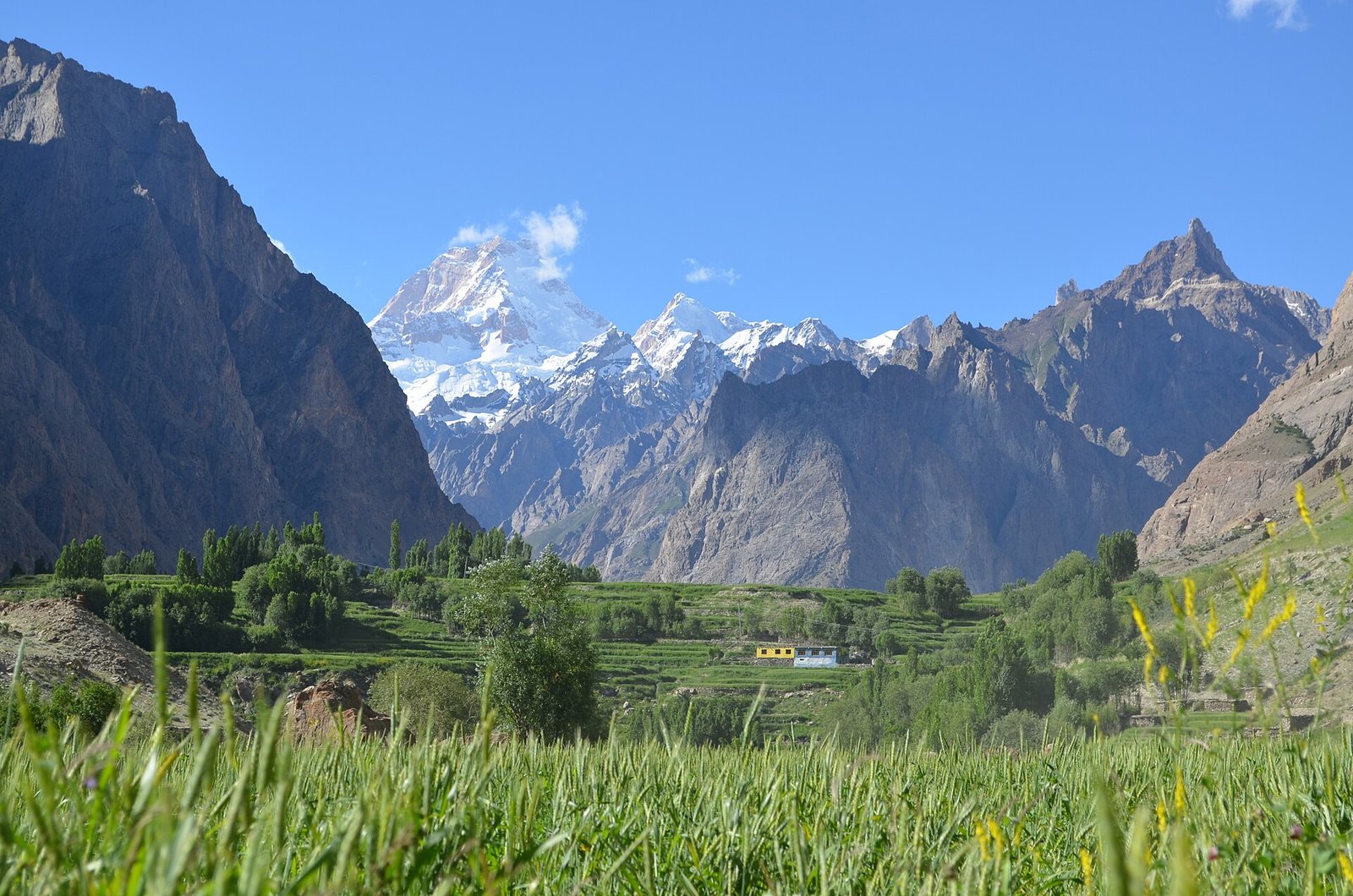
Masherbrum peak seen from Hushe Valley, Baltistan
Destination guide

Hushe Valley: The Complete Travel Guide

Hushe Valley runs north from Khaplu to the foot of Masherbrum, a Balti farming valley that doubles as one of the Karakoram’s great climbing and trekking gateways.

Updated October 2026By The Golden Adventure team
Photo: Zafaryaab / Wikimedia Commons, CC BY-SA 4.0 (source)

Hushe Valley at a Glance

Hushe Valley climbs from the Shyok River at Khaplu to Hushe village, the last settlement before the glaciers of Masherbrum, K6 and K7. It is the end point of the Gondogoro La trek and the start of several shorter base camp treks, so it suits both serious trekkers and travellers who simply want to see the high Karakoram from a quiet Balti village.

LocationGhanche District, eastern Baltistan, Gilgit-Baltistan
AltitudeHushe village about 3,180–3,250 m; Masherbrum 7,821 m
Best time to visitJune to September (July–August for high treks)
Getting thereFly or drive to Skardu, then 4×4 via Khaplu (about 140 km from Skardu)
Top sightsMasherbrum views, Saicho meadow, Charakusa Valley, Khaplu Palace en route
Known forGondogoro La exit, Balti porters and climbers, granite big walls

Where Is Hushe Valley?

The Hushe Valley lies in Ghanche District in the far east of Baltistan. It branches north from the Shyok River near Khaplu and runs straight towards Masherbrum (7,821 m), the mountain the 1856 Great Trigonometrical Survey labelled K1. Wikipedia’s Masherbrum entry notes that the normal climbing route approaches through this valley, which flows south from the summit.

The Gilgit-Baltistan tourism department puts the valley about 140 km from Skardu. From Khaplu the jeep road crosses the Shyok near Surmo, roughly 10 km east of town, then climbs past Machulo and several smaller villages to Hushe. One climbing guide gives the stages as about 20 km to Machulo and a further 37 km to Hushe, fording small streams on the way.

Above Hushe the valley splits into glacier branches: Masherbrum and Gondogoro to the north, Charakusa to the north-east. Everything beyond the village is trekking country.

History & People of Hushe Valley

The people of the valley are Balti, speaking a Tibetic language and following Islam, as across Baltistan. Hushe village had 931 residents in 1994 according to Wikipedia, which also describes it as once one of the poorest villages in a very remote valley.

That changed with mountaineering. Since the 1960s Hushe men have worked as cooks, porters and later high-altitude climbers for foreign expeditions, and the provincial tourism site describes the valley as home to many well-known high-altitude porters. Trekking income means the village is no longer the poorest in the valley, but life still follows the farming year: barley and wheat terraces, apricot trees and summer grazing in the high pastures.

Masherbrum itself was first climbed in 1960 by George Bell and Willi Unsoeld via the south-east face, with Nick Clinch and the Pakistani climber Jawed Akhter reaching the top two days later.

MUST-SEE EXPERIENCES

Top 9 Things to Do in Hushe Valley

These are the experiences that make the long drive up the Hushe Valley worthwhile.

  1. 01
    Viewpoint

    Wake up to Masherbrum from Hushe village

    On a clear morning the south face of Masherbrum fills the head of the valley, a wall of roughly 4,000 m above the glacier. Sunrise from the village fields is the classic photograph.

  2. 02
    Adventure

    Trek to Masherbrum Base Camp

    The most popular trek from Hushe follows the Masherbrum Glacier to a base camp at about 4,300–4,500 m. Allow around five to six days return with acclimatisation; our <a href=”/masherbrum-base-camp-trek/”>Masherbrum Base Camp trek</a> follows this route.

  3. 03
    Adventure

    Finish the Gondogoro La crossing

    Trekkers coming from Concordia cross the 5,585 m Gondogoro La and walk down through Khuispang and Saicho to Hushe. Seeing the valley this way, after two weeks on the Baltoro, is unforgettable.

  4. 04
    Nature

    Camp at Saicho meadow

    Saicho is a grassy camp about an hour’s walk above Hushe village, where the Gondogoro and Charakusa valleys meet. It makes an easy overnight for non-trekkers who still want a night under the peaks.

  5. 05
    Adventure

    Explore the Charakusa Valley

    The Charakusa Glacier leads to the granite walls and peaks around K6 and K7, a magnet for big-wall climbers. A trek to the Charakusa basin takes about two days each way from Hushe.

  6. 06
    Viewpoint

    See Laila Peak’s spear-shaped summit

    Laila Peak (about 6,096 m) above the Gondogoro Glacier is one of the most photographed mountains in the Karakoram. Its base camp is a moderate trek; see our <a href=”/laila-peak-base-camp-trek/”>Laila Peak Base Camp trek</a>.

  7. 07
    Culture

    Walk through Balti village life

    Stone houses, irrigation channels, threshing floors and apricot trees line the road through Machulo, Kande and Hushe. Ask your guide before photographing people, especially women.

  8. 08
    History

    Stop at Khaplu Palace on the way

    Khaplu, at the mouth of the valley, has the restored 19th-century Khaplu Palace and the Chaqchan Mosque. Many travellers break the journey here; read our <a href=”/khaplu/”>Khaplu guide</a>.

  9. 09
    Food

    Eat a Balti meal in a village camp

    Food in the valley is simple and filling: chapati, dal, potatoes, rice and apricots in season. Bring a few favourite snacks for long walking days.

Best Time to Visit Hushe Valley

The provincial tourism department recommends June to September, with June to August the peak trekking and climbing season and September bringing clearer skies for photography. Glacier treks above the village are best in July and August, when the snow has melted back from the camps.

May and October are possible for the lower valley and Saicho, but nights are cold and some trails can still hold snow. Winter brings heavy snow, very low temperatures and limited services, so we do not recommend trips between November and March unless you are well equipped and flexible.

SeasonConditionsGood for
JuneGreen fields, snow still high upVillage stays, Saicho, early treks
July–AugustWarmest, busiest, best trail accessMasherbrum BC, Charakusa, Gondogoro La exit
SeptemberClear, crisp, quieterPhotography, shorter treks
November–MarchHeavy snow, very coldNot recommended

How to Get to Hushe Valley

Every trip starts in Skardu. Flights from Islamabad take about an hour and are weather-dependent; the alternative is a long road journey, which we explain in how to get to Skardu. From Skardu a 4×4 follows the Indus and Shyok rivers to Khaplu and then turns up the valley road.

RouteDistanceTypical time
Islamabad – Skardu (flight)–About 1 hour, weather permitting
Skardu – Khaplu (road)About 100 km2.5–3.5 hours
Khaplu – Hushe (jeep)About 65–70 km3–4 hours, depending on the road
Skardu – Hushe (direct)About 140 km5–6 hours

Road times are indicative. Landslides and stream crossings can add hours, especially in July and August.

Getting Around the Valley

There is no public transport worth relying on above Khaplu, so travellers use a private 4×4 with a local driver. Above the village, porters carry camp equipment. A climbing source lists a 25 kg load limit per porter, so plan your kit accordingly.

Where to Stay in Hushe and Khaplu

Accommodation is basic. Hushe has a few simple guesthouses and campsites used by trekking groups, and most organised trips camp in tents with a cook team. Khaplu, at the mouth of the valley, has the widest choice of hotels and guesthouses, including the heritage hotel in the restored Khaplu Palace.

Expect shared bathrooms and limited hot water and power.

Suggested Itineraries

3 days from Skardu: village and meadow

Day 1 drive Skardu to Khaplu and visit the palace. Day 2 continue to Hushe and walk to Saicho for the night. Day 3 return to Skardu.

7–8 days: Masherbrum Base Camp

Two days to reach Hushe via Khaplu, four to five days trekking to base camp and back, then the drive out. Spare days are wise.

2–3 weeks: K2 Base Camp and Gondogoro La

Trek up the Baltoro from Askole to Concordia and exit over the pass into the valley. Our Gondogoro La trek guide explains each stage, and the Gondogoro La trek page has our departure details.

What to Pack for the Valley

  • Warm sleeping bag (comfort rating around -10°C for treks)
  • Broken-in trekking boots and gaiters
  • Down jacket, fleece and waterproof shell
  • Sun hat, glacier glasses and high-SPF sunscreen
  • Headtorch, power bank and spare batteries
  • Water purification and a reusable bottle
  • Modest clothing for villages (long sleeves, loose trousers)
  • Cash in Pakistani rupees; there are no ATMs in the upper valley

Combine Hushe Valley with Nearby Destinations

The valley pairs naturally with Khaplu and the Shyok valley, and with Skardu’s lakes and the Shigar Valley on the way back. Trekkers often combine it with the Baltoro: in via Askole, out via Gondogoro La.

Culture & Etiquette

Baltistan is conservative and devout. Dress modestly, ask before photographing anyone, and avoid public displays of affection. Remove shoes when entering homes and mosques. Alcohol is not available and should not be brought into villages.

Practical Travel Tips

Safety and travel advice

The US State Department rates Pakistan overall at Level 3, Reconsider Travel, and gives no separate higher warning for Gilgit-Baltistan. The UK FCDO advises against all travel on the Karakoram Highway between Mansehra and Chilas, which is one reason we fly clients to Skardu. Read the US advisory and FCDO advice before booking, and check your insurance covers trekking at altitude.

Permits

The village is open to visitors, but treks into the glacier valleys above it are in a restricted zone and in Central Karakoram National Park. Foreigners need a trekking permit, a licensed guide and insurance, arranged through a licensed operator. We handle this for our clients.

Mountain hazards

The upper valley is serious terrain. In July 2025 the German biathlon champion Laura Dahlmeier died on Laila Peak after being hit by falling rock, a reminder that rockfall and avalanche risk are real even for experts. Read our altitude sickness guide before any trek.

Money and connectivity

Carry enough cash from Skardu. Mobile signal is patchy in Hushe and absent once you start trekking.

HUSHE VALLEY TRAVEL

Hushe Valley Highlights at a Glance

Few valleys put you so close to 7,000 m peaks with so little effort. From the Hushe Valley road you can see Masherbrum, and within a day’s walk you can be at Saicho with Laila Peak above you.

For trekkers, the valley is the finish line of the Gondogoro La and the start of Masherbrum, Charakusa and K6 base camp routes. For everyone else, it is a rare chance to stay in a Balti mountaineering village.

The Gilgit-Baltistan tourism department lists June to September as the best months for trips here.

Plan your Hushe Valley trip

Hushe Valley Tours with The Golden Adventure

Our team in Gilgit runs three treks that use the valley: the Masherbrum Base Camp trek, the Laila Peak Base Camp trek and the classic Gondogoro La trek, which ends in the valley. We arrange permits, guides, porters and transport from Skardu, and can add a night in Khaplu.

Plan your trip to Hushe

Tell us your dates and interests and our team in Gilgit will design a private trip and send your free Letter of Invitation.

Hushe Valley FAQs

Where is Hushe Valley?

It is in Ghanche District, Gilgit-Baltistan. It runs north from Khaplu on the Shyok River to Hushe village at the foot of Masherbrum, about 140 km from Skardu.

How long does it take to get to Hushe from Skardu?

Allow about 5–6 hours by 4×4, longer if there are landslides. Many people break the journey in Khaplu.

Do I need a permit to trek from Hushe?

Visiting the village does not need a special permit, but treks to Masherbrum, Charakusa, K6 or the Gondogoro La are in a restricted zone and national park. Foreigners need a trekking permit, a licensed guide and insurance, arranged through a licensed operator such as TGA.

Is Hushe Valley safe for foreign travellers?

Gilgit-Baltistan is not singled out for a higher warning by the US State Department, which rates Pakistan as a whole at Level 3. The bigger risks in the valley are mountain hazards, altitude and road conditions. Check the latest US and UK advice and travel with a licensed operator.

When is the best time to visit Hushe Valley?

June to September. July and August are best for glacier treks; September is quieter with clear skies.

Can non-trekkers enjoy the valley?

Yes. You can drive to Hushe, stay in a simple guesthouse or camp, and walk an hour to Saicho meadow for big mountain views without a multi-day trek.

How hard is the Masherbrum Base Camp trek?

It is a moderate glacier trek reaching about 4,300–4,500 m, usually done in 5–6 days return from Hushe. You need good fitness and acclimatisation, and the upper section crosses crevassed ice with a guide.

TGA AI AssistantOnline · usually replies in seconds
AI can make mistakes. Please don't share personal, passport or card details.