thegoldenadventure.com

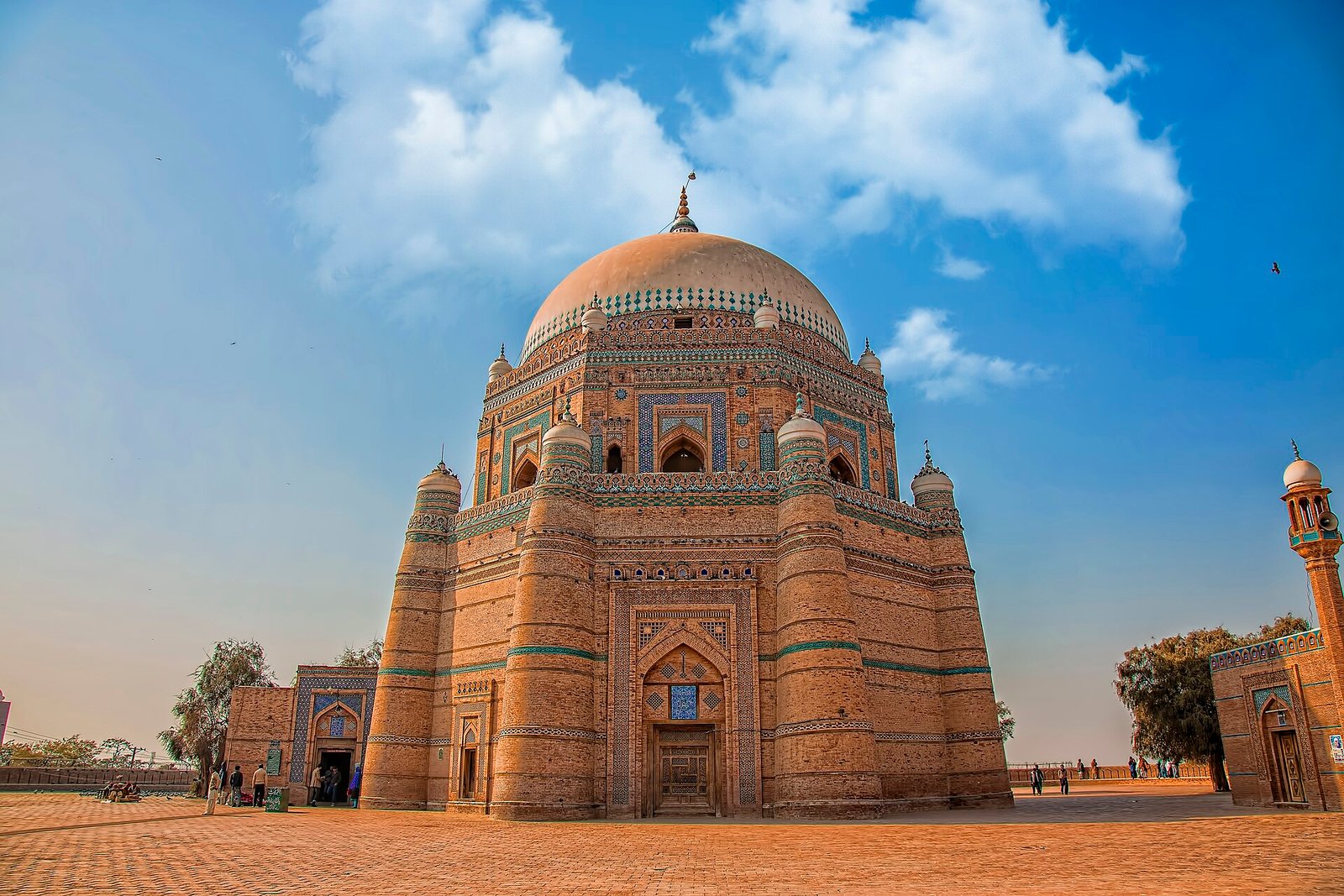
Multan: the Tomb of Shah Rukn-e-Alam
Destination guide

Multan: The Complete Travel Guide

Multan, the City of Saints, is one of Asia’s oldest living cities, crowned by tiled Sufi tombs that glow turquoise and brick-red above the plains of southern Punjab.

Updated October 2026By The Golden Adventure team
Photo: Tahsin Shah / Wikimedia Commons, CC BY-SA 4.0 (source)

Multan at a Glance

Multan is a city of more than two million people on the east bank of the Chenab, and Pakistan’s sixth-largest city. Sufi saints settled here from the 11th century onwards, leaving magnificent tombs that still draw pilgrims from across South Asia.

LocationSouthern Punjab, on the east bank of the Chenab River
PopulationAbout 2.2 million (2023 census)
Best time to visitNovember to February; summers are among the hottest in Pakistan
Getting thereMultan International Airport, or about 333 km from Lahore by motorway
Top sightsShah Rukn-e-Alam, Bahauddin Zakariya, Shah Shams Sabzwari, the walled city
Known forSufi shrines, blue glazed tiles, sohan halwa, mangoes

Where Is Multan?

The city lies in the hot, flat heart of southern Punjab, close to where the region’s great rivers converge. It is the headquarters of its own division and district, and the cultural capital of the Saraiki-speaking belt; Saraiki is the most widely spoken language, ahead of Urdu and Punjabi.

It is well connected: the M-4 motorway runs north towards Faisalabad and Lahore, the M-5 runs south towards Sukkur and Sindh, and the international airport is about 10 km west of the centre. Bahawalpur is roughly 100 km to the south-east.

History of Multan

This is one of the oldest continuously inhabited cities in Asia. Alexander the Great besieged the capital of the Malli here in 326 BC and was badly wounded in the assault. A famous Sun Temple stood here until it was destroyed in the late 10th century, and the remains of the Prahladpuri Temple still sit on a platform on the old fort mound.

Muhammad bin Qasim captured the city in 712, Mahmud of Ghazni took it in 1010, and it later passed to the Delhi Sultanate, the local Langah Sultanate and the Mughals. Ranjit Singh’s Sikh Empire held it from 1818, and the British took it after a long siege in 1848–49 that badly damaged the shrine of Bahauddin Zakariya.

The City of Saints

From the 11th and 12th centuries, Sufi mystics made the city a centre of devotion. Their shrines, built of red brick with shisham-wood beams and panels of blue, azure and white glazed tiles, created a regional style still visible across the old city.

MUST-SEE EXPERIENCES

Top 10 Things to Do in Multan

These are the essential sights and experiences, starting with the great shrines on the old fort mound.

  1. 01
    History

    Tomb of Shah Rukn-e-Alam

    Built between 1320 and 1324, this octagonal tomb is about 35 m tall and is considered one of the finest Tughluq-era buildings anywhere. Its dome is reputedly among the largest in South Asia, and the tomb is on UNESCO’s tentative list.

  2. 02
    History

    Shrine of Bahauddin Zakariya

    The tomb of the saint who settled here in 1222 and died in 1267, a leading figure of the Suhrawardi order. Nearly destroyed in the 1848 siege, it was restored soon after and remains a busy place of prayer.

  3. 03
    Culture

    The walled city and its bazaars

    Enter through gates such as Bohar, Haram, Delhi or Lohari into lanes of spice sellers, cloth merchants and craftsmen. Hussain Agahi bazaar is the best-known market; bargaining is expected.

  4. 04
    History

    Shrine of Shah Shams Sabzwari

    Built in 1330 by the saint’s grandson, east of the fort, this square tomb with a green dome hosts a well-attended urs.

  5. 05
    History

    Shrine of Shah Yusuf Gardezi

    Just inside Bohar Gate, this unusual domeless shrine is covered in glazed tiles. The saint is said to have arrived in 1088 and is regarded as a founder of the medieval city.

  6. 06
    History

    Qasim Fort mound

    The old citadel survives as a raised mound and park around the shrines. A rehabilitation project begun in December 2024 is due to finish in December 2026, adding retaining walls and clearing encroachments.

  7. 07
    Viewpoint

    Ghanta Ghar (Clock Tower)

    A British-era clock tower from the late 1800s near the old city, being converted to house a city museum.

  8. 08
    Culture

    Blue pottery workshops

    Local potters still make blue-glazed tiles and ceramics in the style seen on the shrines. A painted bowl or tile is the classic souvenir.

  9. 09
    Food

    Sohan halwa

    The city’s famous dense, nutty sweet, sold in round tins all over town. It travels well and makes a good gift.

  10. 10
    Food

    Mango season

    Mango orchards surround the city. If you visit in early summer, the fruit is superb, even if the heat is fierce.

Best Time to Visit Multan

Come between November and February. The city has a hot desert climate and is one of the hottest places in Pakistan; the record high is 50 °C, set in May 2010. Winter days are mild and generally sunny.

Rainfall averages only around 200 mm a year, mostly in the July–September monsoon. Shrines are busiest during each saint’s urs; the festival at Shah Rukn-e-Alam draws more than 100,000 pilgrims. Urs dates follow the Islamic calendar, so they move each year.

How to Get to Multan

The easiest route for most foreign travellers is a domestic flight or a drive from Lahore on the motorway. There are also train services to Multan Cantonment station from the major cities.

FromModeDistance / time
LahoreRoad via M-3 and M-4About 333 km; allow 4 hours or more with stops
Islamabad or KarachiDomestic flightAbout 1.5 hours
BahawalpurRoadAbout 100 km; under 2 hours
SukkurRoad via M-5Motorway link to Sindh

Getting Around the City

The main shrines are close together on and around the fort mound, and the walled city is best explored on foot. For longer hops, a car with driver or a rickshaw is simplest. A Metrobus line has run since 2017, but routes are aimed at commuters rather than visitors.

Where to Stay

Choose a mid-range or business hotel outside the congested walled city; the shrines are then a short drive away. The city has accommodation for all budgets, and we can suggest current options that suit your plans.

Suggested Itineraries

One full day

Morning at Shah Rukn-e-Alam and Bahauddin Zakariya on the fort mound, lunch, then Shah Yusuf Gardezi and the bazaars of the walled city. End at Shah Shams Sabzwari in the late afternoon.

Two days

Add blue-pottery workshops, the Clock Tower area and an unhurried evening in the bazaars.

Southern Punjab loop (4–5 days)

Continue to Bahawalpur for Noor Mahal, Uch Sharif and the Cholistan desert, then return north or fly out.

What to Pack

  • Loose, light clothing covering arms and legs
  • A headscarf for women, needed at the shrines
  • Slip-on shoes, as you will remove them often
  • A warm layer for cool winter evenings
  • Sun hat and high-factor sunscreen
  • Small notes for shrine donations and bazaar purchases

Combine with Nearby Destinations

The city is the natural gateway to southern Punjab. Bahawalpur and the Cholistan desert lie a couple of hours south, and many travellers arrive from Lahore, Pakistan’s cultural capital. Read our guide to Pakistani food for regional dishes to try along the way.

Culture & Etiquette

The shrines are active places of worship. Remove shoes where others do, women should cover their hair, and everyone should dress modestly. Shrines can be very crowded on religious occasions, so keep valuables close.

Ask before photographing people, particularly women and those at prayer. If you are unsure whether you may enter a particular area, ask the caretakers and follow their lead.

Practical Travel Tips

Safety: The city itself is not on the UK FCDO’s list of areas to avoid. However, the FCDO advises against all but essential travel to Dera Ghazi Khan district to the west, so do not head that way without checking. The US State Department rates Pakistan overall at Level 3, ‘Reconsider travel’. Read the latest FCDO advice and our guide Is Pakistan safe?

Money and SIMs: Carry cash for the bazaars and shrine donations; see money in Pakistan and our Pakistan SIM card guide. Work on the Qasim Fort rehabilitation may close parts of the fort mound until it finishes.

MULTAN TRAVEL

Multan Highlights at a Glance

Few cities in Pakistan carry so many layers of history: Alexander’s siege, medieval sultanates, Sufi saints and British cannon all left their mark here.

It rewards travellers interested in Islamic architecture, Sufi music and crafts, and pairs naturally with Lahore and Bahawalpur on a winter trip.

For more on the tombs and their tilework, see the overview of the city’s mausoleums.

Plan your Multan trip

Multan FAQs

Why is Multan called the City of Saints?

Many Sufi mystics settled here in the 11th and 12th centuries, and their tombs, including Bahauddin Zakariya and Shah Rukn-e-Alam, made it one of South Asia’s great pilgrimage centres.

When is the best time to visit?

November to February. Summers are extremely hot, with a record of 50 °C, while winter days are mild and sunny.

How do I get there from Lahore?

By road it is about 333 km via the M-3 and M-4 motorways. There are also trains and domestic flights from other major cities.

How many days do I need?

One full day covers the main shrines and the old city. Two days lets you explore the bazaars and crafts at a relaxed pace.

Is Multan safe for foreign tourists?

The city is not on the UK FCDO’s list of areas to avoid, though nearby Dera Ghazi Khan is. The US rates Pakistan overall as Level 3, so check current advice and travel with a reputable operator.

Can non-Muslims visit the shrines?

Usually yes, if you dress modestly and behave respectfully, but follow the caretakers’ guidance. Remove shoes where required and women should cover their hair.

What should I buy?

Blue-glazed pottery and tiles, and the city’s famous sohan halwa, are the classic souvenirs.

TGA AI AssistantOnline · usually replies in seconds
AI can make mistakes. Please don't share personal, passport or card details.